 TheIBAxolotl
Lessons / Biology / IB Biology | Year 1 (Junior) / IB Biology · B1.2 Proteins (SL & HL) · part 3/7
Protein Structure IB Biology: Alpha Helix vs Beta Sheet
Plays on through the playlist · IB Biology B1.2 Proteins (SL & HL) | Amino Acids & Protein Structure (8 videos) on YouTube
What you'll learn
IB Biology B1.2, proteins: R-groups, primary structure and secondary structure, the alpha helix and the beta-pleated sheet (part 3 of 7, higher level). The chemical types of R-group, why the sequence of amino acids decides the shape, and how the alpha helix and the beta-pleated sheet are held by hydrogen bonds in the backbone.
In this lesson
Practice questions
- State the three chemical types of R-group. [1]
- Outline how an R-group can become negatively charged. [1]
- Explain why a polypeptide with a given sequence always folds into the same shape. [2]
Original questions in the style of the exam. Try them after the video, then check the answers below.
Answers to the practice questions
- Non-polar (hydrophobic), polar and charged.
- A carboxyl group in the R-group loses a hydrogen ion.
- Each R-group has its own chemical properties, so the sequence fixes which interactions form [1]; that is why the same sequence always folds in the same way [1].
Try them at the end of the video first. Questions are original, in the style of the exam; marks are estimates.
Read the lesson (full transcript)
A five mark exam question, for higher level. In seven minutes you will answer both parts, and you will know where each mark comes from.
This is part three of seven about proteins. Parts one and two gave you the amino acid, the peptide bond and denaturation. Now we look at how a chain folds.
Two questions from the earlier parts. Which part is different in every amino acid?
The R-group.
Second. Does denaturation break the peptide bonds?
No. It breaks the bonds between R-groups. Today you learn what those R-groups are like, and which bonds come first.
The twenty R-groups are chemically different. Some are non-polar. They are hydrophobic: they stay away from water. Some are polar. They are hydrophilic. And some carry a charge, positive or negative. They are hydrophilic too.
Where do the charges come from? Some R-groups contain a carboxyl group, which can lose a hydrogen ion and become negative. Some contain an amine group, which can gain a hydrogen ion and become positive.
You do not need to memorize which amino acid has which R-group. You need the idea: this chemical variety is the reason why proteins can have so many shapes and so many functions.
Small task. A non-polar R-group. Does it stay in contact with water, or away from it?
Away from it. It is hydrophobic.
A protein has up to four levels of structure. Level one is the primary structure. It is the sequence of amino acids in the polypeptide: which amino acids, how many, and in what order. The sequence is set by a gene.
The primary structure decides everything that follows. Each R-group has its own chemistry, so the chain can fold in only one stable way. The same sequence always gives the same three-dimensional shape. Folding is precise, and it is repeatable.
Change one amino acid, and one R-group changes. The interactions change, and the final shape can change too.
Small task. What sets the order of amino acids in a polypeptide?
A gene.
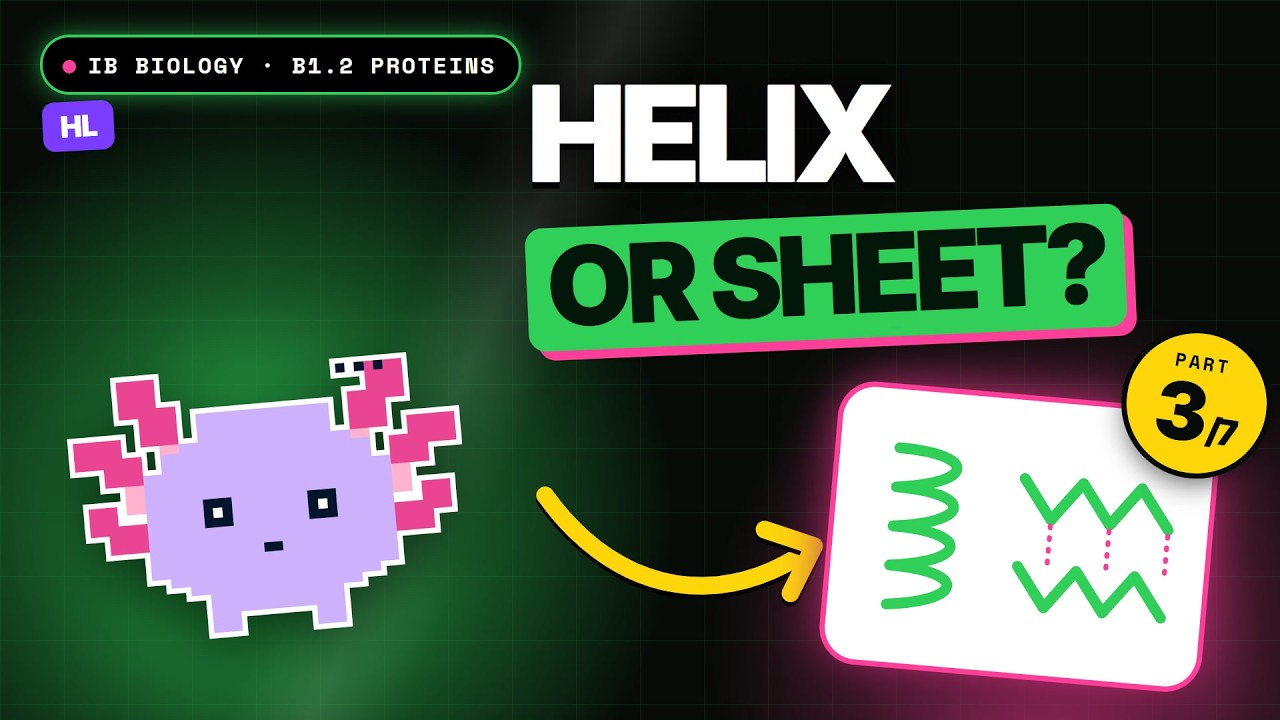
Level two is the secondary structure. Parts of the chain coil into a spiral called an alpha helix. Other parts fold into a beta-pleated sheet: sections of the chain lie side by side, like a folded sheet of paper.
Both shapes are held by hydrogen bonds. Each hydrogen bond forms between the oxygen of a C double bond O group and the hydrogen of an N H group. These groups belong to the peptide bonds, so they are part of the backbone of the chain. They are spaced regularly, and that is why the shapes are regular.
Careful here. In secondary structure the hydrogen bonds are between atoms of the backbone. The R-groups are not involved yet. They come in at level three, in the next video.
Small task. Name the two shapes of secondary structure.
Alpha helix, and beta-pleated sheet.
Three questions. I answer the first, we share the second, you answer the third.
Why do R-groups allow many shapes? One: R-groups differ chemically. Some are hydrophobic, some are hydrophilic. Two: so different sequences form different interactions, and fold into different shapes.
Why can one changed amino acid change the shape? I wrote the first point: the new amino acid has a different R-group. You finish the chain.
So the interactions change, and the polypeptide folds differently.
Now alone. Distinguish between an alpha helix and a beta-pleated sheet. Pause the video.
The alpha helix is a coil, a spiral. In the beta-pleated sheet, sections of the chain lie side by side and are folded. "Distinguish" asks for the difference, so you do not need to say that both use hydrogen bonds.
Two marks, three answers. Decide. Five seconds.
Student A described tertiary structure, not secondary. Zero. Student B named the type of bond. One mark. Student C also said exactly where the bonds form. Two marks.
In every question about protein structure, give the type of bond, and say where it forms.
Back to the question from the start. Pause the video and try both parts.
Part a. The primary structure is the sequence of amino acids in the polypeptide. One mark. It is determined by a gene, and it determines how the chain folds. One mark.
Part b. Secondary structure is the regular coiling or folding of parts of the chain. One mark. The two forms: alpha helix and beta-pleated sheet. One mark. They are held by hydrogen bonds between C double bond O and N H groups of the backbone. One mark.
Five out of five.
One screen. R-groups can be non-polar, polar or charged. Primary structure is the sequence of amino acids, and it decides the shape. Secondary structure is the alpha helix and the beta-pleated sheet, held by hydrogen bonds in the backbone.
Three questions. Try them today, and again in three days. Next, the last part: the R-groups fold the whole chain, chains join together, and shape meets function. See you there!
Practice this topic
IB Biology B1.2 Proteins: questions and flashcards
Original exam-style questions with markschemes. Free, no account.
Watch next
 D4.1
 D4.1
 S1.2