 TheIBAxolotl
Lessons / IB Study Skills, TOK & EE / Extended Essay & Mock Exam Prep (IB2) · part 01
Extended Essay Criteria: 5 Checks (30 Marks)
Plays on through the playlist · IB Study Skills, TOK & EE (2 videos) on YouTube
What you'll learn
A final pass for your IB extended essay, one check per criterion: framework, knowledge and understanding, analysis and line of argument, discussion and evaluation, and reflection. Plus what counts towards the 4,000 words and two quick checks for your references. For IB Diploma students in their second year (IB2).
In this lesson
Read the lesson (full transcript)
By the end of this video, you will check your own extended essay against these thirty marks.
Five checks, one for each criterion: framework, knowledge, argument, evaluation, and reflection. These are the criteria for essays assessed from May twenty twenty-seven.
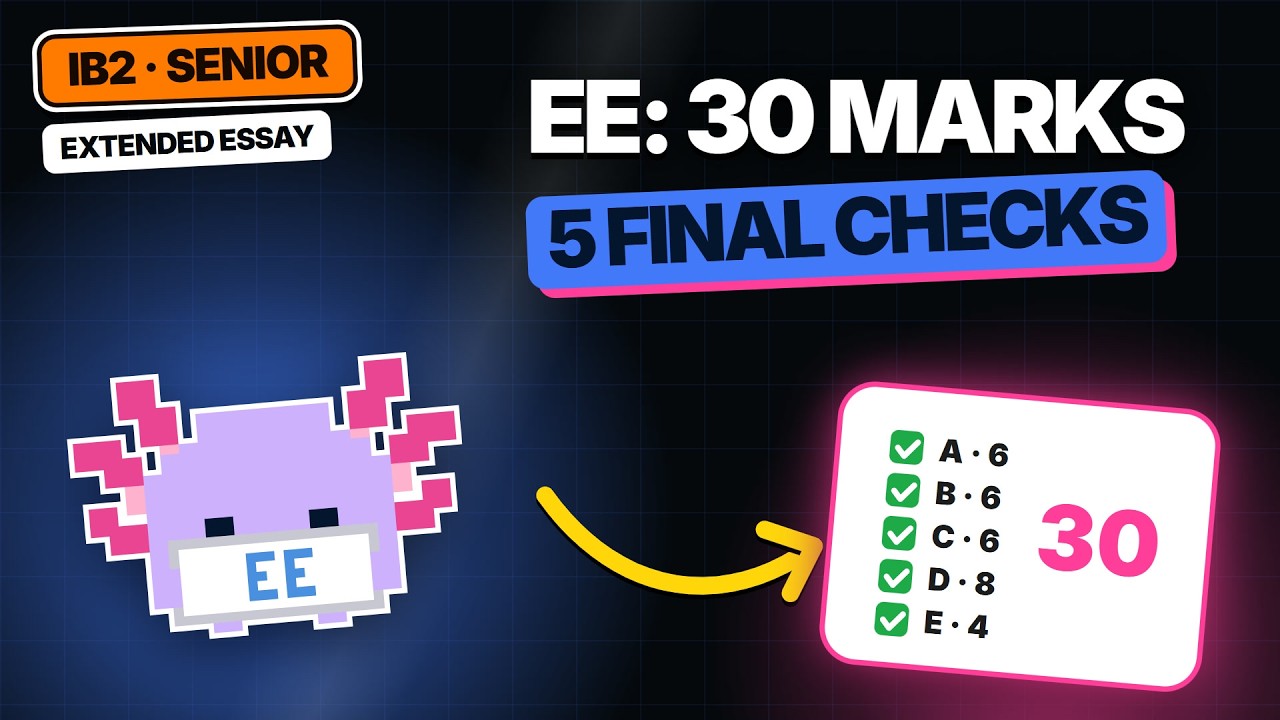
First, see where the marks are. Framework, knowledge, and analysis are worth six marks each. Reflection is worth four. And discussion and evaluation is worth eight, more than any other criterion.
Small task. Analysis, plus discussion and evaluation: how many of the thirty marks is that?
Fourteen. Almost half. So a last edit that only fixes commas is polishing the wrong thing.
Here is how to edit instead. Do not try to fix everything in one read. Do five short passes, one criterion at a time. Each pass has one job.
Check one: the framework. Your research question should appear, word for word, on the title page and in the introduction. And your conclusion must answer that exact question.
Next, your method. Say how you researched the question, and why that approach fits. Then the structure: title page, contents page, introduction, body, conclusion, and references.
Careful here. The essay is anonymous. Your name, your school, and your supervisor's name should not appear anywhere in the file.
Small task. Your conclusion answers a slightly different question from the one on your title page. Is that a problem?
Yes. Make them match, and talk to your supervisor before you change the question.
Check two: knowledge and understanding. This criterion rewards subject concepts and terms, used precisely. So read one page and underline every key term. Is each one used correctly, the way your subject uses it?
Here is a made-up example from a Biology essay. Vague: the plants did better with more light. Precise: the rate of photosynthesis increased with light intensity. Same idea, but the second one shows the examiner that you know the subject.
Check three: analysis and line of argument. Now you are the examiner. Three students write about the same graph. Which sentence builds an argument? You have five seconds.
Student A describes: the table shows the results. Student B analyses: the rate rose, then levelled off. Student C analyses and argues: it levelled off, so another factor became limiting, and light explains the rate only up to a point. That sentence moves the essay forward.
Describe less. Argue more.
Check four: discussion and evaluation. Eight marks, the biggest criterion. Discussion means saying what your findings mean for the research question. Evaluation means judging them.
So ask three questions. How strong is my evidence? What are the limits of my method and my sources? And does my conclusion claim only what the evidence supports?
For example: the light level was read by eye, so small differences between trials may not be real. One sentence like that, next to the result it affects.
Careful here. A classic trap is to put all the limitations in one paragraph at the very end. Evaluate as you go, where each piece of evidence appears.
Now the word limit: four thousand words. Pause the video. Which of these count: quotations, the contents page, footnotes that explain something, tables, and the bibliography?
Quotations count. So do footnotes that explain or add content. The contents page, tables, and the bibliography do not. And the examiner is not required to read past the limit. So if you are over, cut. Start with background that your argument never uses.
While you are there, check your references. Every idea that is not yours needs a citation, in one consistent style. And the bibliography lists only the sources you actually cite.
Small task. A book is in your bibliography, but you never cite it in the essay. What do you do?
Cite it where you used it, or take it out.
Check five: reflection. Four marks, from a reflective statement of up to five hundred words. It goes on a separate form, not in the essay, and you write it at the end, after your final meeting with your supervisor, the viva voce.
Which of these is reflection? One: I read twelve sources. Two: my first sources disagreed, so I narrowed my question. The second. Reflection is about your decisions and what you learned, not a list of what you did.
Your turn. Three sentences from a made-up History essay. Label each one: describes, analyses, or evaluates. Pause the video and try it.
One: the treaty was signed in nineteen nineteen. That describes. Two: the treaty weakened the economy, which fed political anger. That analyses. Three: this source is a memoir written thirty years later, so hindsight may shape its account. That evaluates.
Recap. One: the same research question from the title page to the conclusion. Two: subject terms, used precisely. Three: argue, do not just describe. Four: evaluate as you go. Five: reflect on your decisions.
Two tasks are on screen. Do them on your own draft this week. And always check the details with your supervisor: the guide your school gave you is the final word.
Next Sunday: how to prepare for your mock exams. See you then!