 TheIBAxolotl
Lessons / IB Exam Practice / Paper 1 Step by Step (SL): completing the square · part 01
Completing the Square: 9-Mark Paper 1 in 7 Min
Plays on through the playlist · IB Exam Practice (2 videos) on YouTube
What you'll learn
A nine mark Paper 1 style question on quadratics, solved line by line with no calculator: complete the square, read the vertex and the axis of symmetry, and use the word “hence” to solve the equation. For IB Mathematics: Analysis and Approaches SL (HL students need it too).
In this lesson
Answers to the practice questions
- q(x) = (x − 4)² − 9 [2]; vertex (4, −9) [1]; x − 4 = ±3, so x = 1 or x = 7 [2].
- p(x) = 3(x + 2)² − 7 [3]; the minimum value is −7, so there are no solutions when k is less than −7 [2].
Try them at the end of the video first. Questions are original, in the style of the exam; marks are estimates.
Read the lesson (full transcript)
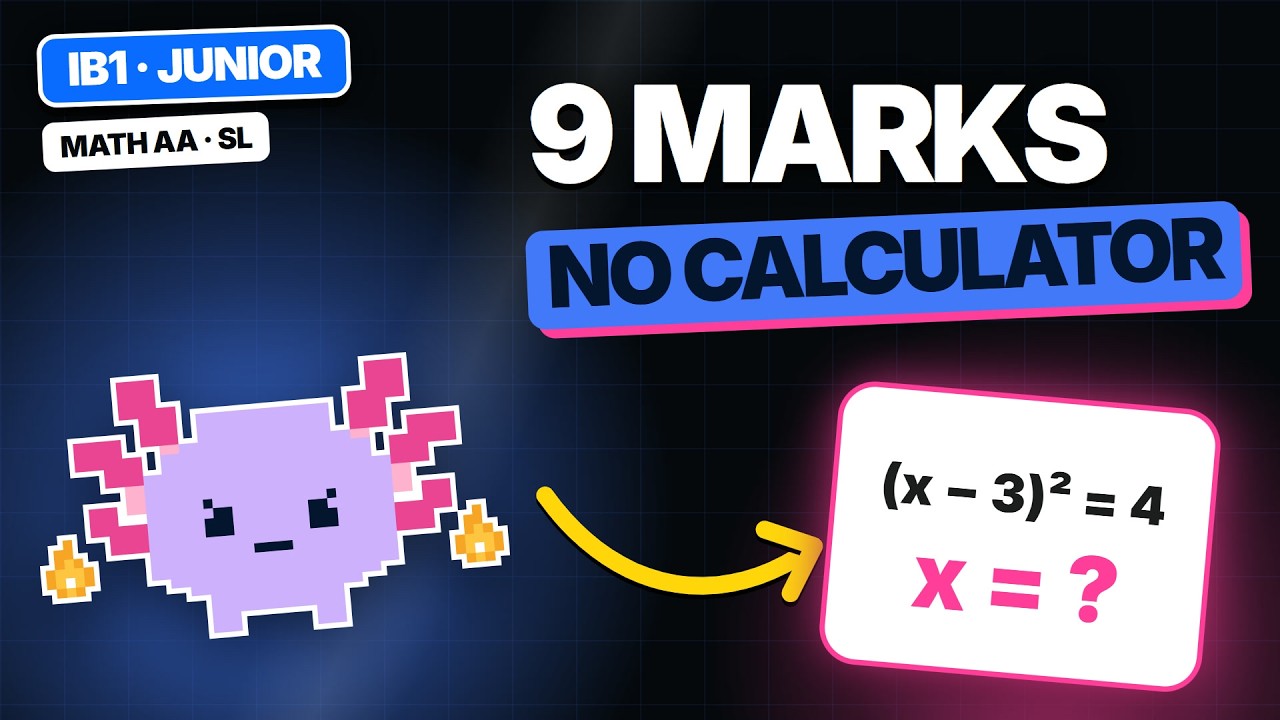
By the end of this video, you will answer this nine mark question. No calculator.
Three moves get you there: complete the square, read the vertex, and use the word hence to solve the equation. This is standard level, Paper 1 style.
First, read the question like an examiner. The marks tell you how much to do: three marks is about three lines of working. Write down means no working is needed, just the answer. And hence means you must use what you just found.
The marks also tell you the time. Paper 1 has eighty marks in ninety minutes. That is a little over one minute per mark. So nine marks is about ten minutes.
Small task. Part b says write down, and it is worth three marks in total. How many lines of working does it need?
None. Just the answers.
Part a. Complete the square. Step one: take the two out of the first two terms only. Two, bracket, x squared minus six x, close bracket, plus ten.
Step two: halve the minus six. That gives minus three. So write x minus three, all squared. But x minus three, squared, is x squared, minus six x, plus nine. We never had that plus nine, so take it away: minus nine.
Step three: multiply the two back in. Two times the bracket squared, then two times minus nine, which is minus eighteen, plus ten. So f of x equals two, x minus three, squared, minus eight.
Careful here. A classic trap is to forget that the minus nine is inside the bracket. It gets multiplied by two as well. Forget that, and you finish with plus one instead of minus eight.
Here is a five second check. Put x equals zero into both forms. The original gives ten. The new form gives two times nine, minus eight. Also ten. It matches.
Part b. Write down the vertex and the axis of symmetry. Pause the video and try it.
The form a, x minus h, squared, plus k, has its vertex at h, k. Here h is three and k is minus eight. So the vertex is the point three, minus eight.
Careful here. The bracket says minus three, but the x coordinate is plus three. Ask yourself: what makes the bracket zero? And the axis of symmetry is the vertical line through the vertex: x equals three. Write x equals, not just three.
Part c. Hence solve f of x equals zero. Hence tells you where to start: from your completed square, not from the original.
Two, x minus three, squared, minus eight, equals zero. Add eight, then divide by two: x minus three, squared, equals four. Now take the square root of both sides: x minus three equals plus or minus two.
So x equals five, or x equals one. That plus or minus is where the second answer comes from.
Does that make sense? Check with a quick sketch. The vertex is at three, minus eight, below the x axis. The curve opens upwards, because a is positive. So it must cross the x axis twice, the same distance each side of the axis of symmetry: three minus two, and three plus two. One and five. The picture agrees with the algebra.
The vertex gives you one more thing for free. The lowest value of f is minus eight. So if a question asks: for which values of k does f of x equals k have no solutions? The answer is k less than minus eight. A horizontal line below the vertex never touches the curve.
Now you are the examiner. Three students answer part c. Who earns all three marks? You have five seconds.
Student A gets to x minus three, squared, equals four, then forgets the square root. One mark. Student B takes the square root, but forgets plus or minus, and finds only five. Two marks. Student C writes plus or minus two, and finds both answers. Three marks.
Square root? Write plus or minus.
Your turn. Same moves, new function. g of x equals x squared, plus four x, minus five. Complete the square, then solve g of x equals zero. Pause the video and try it.
Halve the four: x plus two, all squared. Take away the four you added, then the five: minus nine. Set it to zero: x plus two equals plus or minus three. So x equals one, or x equals minus five.
Recap. The marks tell you how many lines to write. Write down means no working. Hence means use your last answer. And every square root needs plus or minus.
Two more questions are on screen. Try them today. The answers are in the description.
Next Saturday: another Paper 1 question, step by step. Arithmetic sequences. See you then!